Premium vs Overpriced Pricing: Where Most Brands Get It Wrong
- Anwesha Chowdhury

- May 4
- 3 min read
Why do some brands charge more and get rewarded for it, while others charge more and get questioned for it?
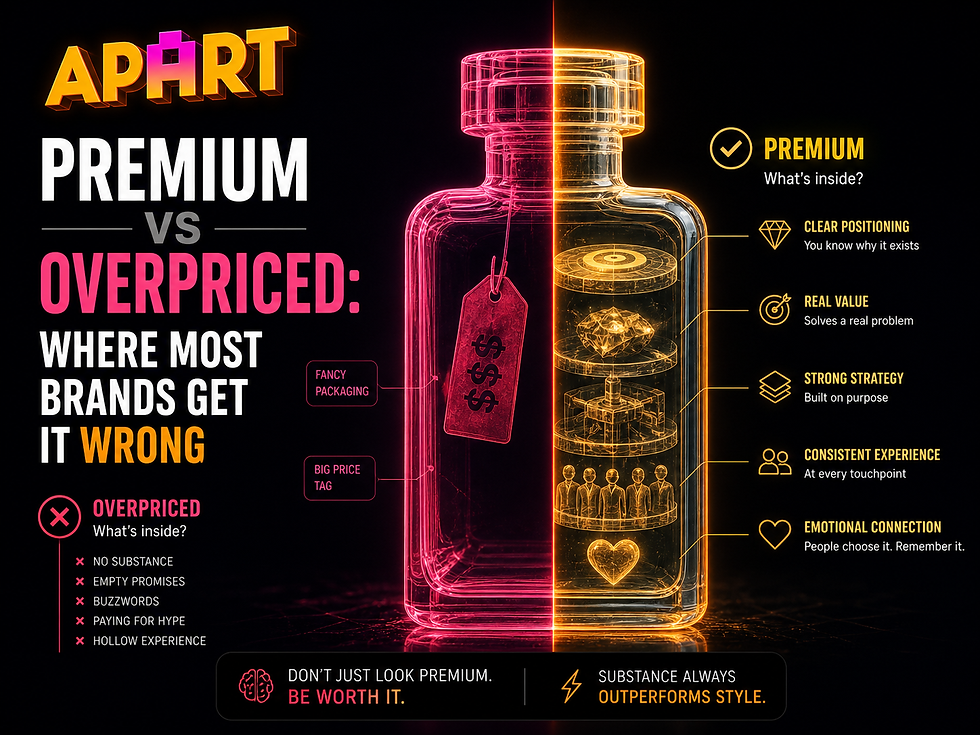
The difference is perceived value.
Many brands attempt to position themselves as “premium” by increasing prices, upgrading visuals, or refining communication. Yet the market response often signals resistance: lower conversions, higher objections, or increased reliance on discounts.
This disconnect comes from a mismatch between price and perceived value.
What actually is Premium vs Overpriced Pricing? Premium pricing works when value is clear, consistent, and experienced. Overpricing happens when that clarity is missing.
Understanding the Difference between Premium vs Overpriced Pricing
The gap between premium and overpriced is not subtle, it’s structural.
Premium Brands
Price aligns with perceived value
Experience matches expectations
Positioning is consistent across touchpoints
Buyers feel confident in the exchange
Overpriced Brands
Price exceeds perceived value
Benefits are unclear or generic
Experience is inconsistent
Buyers hesitate, compare, or delay
The customer response tells you everything:
Premium → “This makes sense.”
Overpriced → “Why does this cost this much?”
Where Brands Get It Wrong
1. Price Increases Without Value Reinforcement
Raising prices without strengthening:
product quality
customer experience
messaging clarity
creates friction.
When the value is not obvious, the price feels arbitrary.
Premium brands build value first—and then price reflects it.
2. Weak Value Communication
Many brands have value—but fail to communicate it.
They rely on:
vague claims
broad positioning
internal language
Instead of:
specific outcomes
real use cases
proof-backed messaging
If the customer cannot quickly understand:
what improves
what changes
what justifies the price
The offer is perceived as expensive rather than premium.
3. Over-Reliance on Discounts
Frequent promotions signal inconsistency in pricing confidence.
Over time, this:
trains customers to wait
reduces perceived value
weakens brand positioning
Premium brands protect price integrity. Discount-driven brands dilute it.
4. Copying Competitor Positioning
Many brands benchmark competitors without understanding:
their cost structure
their audience
their brand equity
As a result, pricing and positioning are replicated without the underlying foundation.
This creates a mismatch between expectation and delivery.
5. Inconsistent Experience Across Touchpoints
Premium perception is built through consistency.
When:
ads feel premium
website feels average
delivery feels inconsistent
trust drops.
Every interaction contributes to perceived value.
Premium vs Luxury: A Strategic Distinction
Understanding this difference is critical before positioning.
Premium Brands
Focus on performance and quality
Justify pricing through benefits and outcomes
Target high-intent, value-conscious customers
Scale through broader distribution
Example approach: Clear messaging, product demos, performance proof.
Luxury Brands
Focus on exclusivity and emotional value
Justify pricing through status, heritage, and scarcity
Target a narrow, aspirational audience
Limit access intentionally
Example approach: Selective availability, storytelling, controlled visibility.
Confusion between these two often leads to misaligned strategies:
premium brands attempting luxury storytelling without credibility
luxury brands diluting exclusivity through scale
How to Build a Truly Premium Brand
1. Strengthen Value Before Pricing
Pricing should reflect:
product quality
customer outcomes
experience depth
Evaluate:
what the customer gains
how clearly that is understood
whether it justifies the price
2. Make Value Immediately Clear
Your messaging should answer:
Why is this worth the price?
This requires:
specificity
clarity
relevance
For example:
Replace “high-quality service”
With “reduce acquisition cost while improving lead quality within 90 days”
Clarity reduces hesitation.
3. Build Proof Into the Experience
Premium brands demonstrate value through:
testimonials
measurable outcomes
real examples
Proof shifts perception from claim to credibility.
4. Align Every Touchpoint
Consistency across:
brand identity
messaging
product experience
customer journey
ensures that perception matches expectation.
Premium is not communicated once. It is reinforced repeatedly.
5. Maintain Pricing Discipline
Avoid:
excessive discounts
inconsistent pricing
reactive promotions
Pricing discipline strengthens perceived value over time.
6. Understand Customer Psychology
Customers evaluate:
functional benefits
emotional payoff
perceived risk
Premium positioning requires alignment across all three.
Even in B2B, decisions are influenced by confidence, trust, and perceived impact.
Why Premium Positioning Fails
Misaligned Execution
Strong positioning with weak delivery creates a credibility gap.
Overstated Claims
Exaggeration without proof reduces trust.
Inconsistent Branding
Shifts in tone, visuals, or messaging weaken recognition.
Lack of Experience Design
Premium perception is influenced by:
onboarding
communication
support
Not just the product itself.
The Role of Perception
Perception is built through:
repeated exposure
consistent experience
reinforced messaging
It is not controlled by what the brand claims, but by what the customer experiences.
When perception aligns with price, premium positioning becomes sustainable.
When it does not, resistance increases.
Closing Perspective
Premium pricing is not a positioning tactic. It is an outcome of:
clarity
consistency
credibility
Brands that invest in these areas build trust and justify pricing naturally.
Brands that skip them rely on explanation, promotion, or justification.
And those rarely scale.
If your pricing is being questioned, the issue lies in how value is positioned, communicated, and experienced.
APART works with founders and marketing teams to:
define clear brand positioning
build high-converting messaging
align content, branding, and perception
Book a strategy session with APART and fix the gap between your price and your perceived value.